When a contractor needs artwork that works on site and off site
Contractors usually contact us when an old logo is blurry, the only file they have is a photo, or the artwork was made long ago and no longer prints properly. That becomes a problem on vehicle doors, corrugated site boards, hard hats, proposal packs and workwear where fine detail can disappear fast.
A proper redraw gives you artwork that can be scaled up for a billboard style board or reduced for a small invoice header without losing shape. It also helps when the same logo has to sit on printed quote packs, embroidered shirts, vinyl cut lettering and digital documents for municipal or private client submissions.
What contractors usually send us first
The starting point can be simple. A clear photo of a sign, a scan from a letterhead, a screenshot from a PDF, or even a faded image from an old truck sign is often enough to begin. If the logo includes text, we check spacing, letter shape and any small marks that matter for the redraw.
- A photo of a vehicle decal or shopfront sign
- A scan from an old invoice, quote or safety notice
- A PDF with low resolution artwork
- An embroidery file that needs proper vector artwork
- A sketch or rough drawing for a new mascot or badge
Clients must own the artwork they send or have permission to use it. That is important for contractor brands too, especially where logos, badges or site graphics include symbols from another party.
Bitmap tracing versus a hand redraw for contractor artwork
Some artwork can be traced from a bitmap image, but that is not always the best route. Tracing follows the pixels in a photo or low-res file, which can carry over rough edges, warped curves and stray details from a bad original. It is useful in some cases, yet it does not always suit a logo that needs to look tidy on a sign or truck.
A hand redraw is often better for contractor brands because it rebuilds the artwork with proper curves, cleaner line weight and balanced spacing. This matters where the design must work on vinyl, screen print, embroidery, laser cutting or laser engraving. For more illustrated marks, we can also create a fresh hand-drawn vector version rather than forcing everything through trace lines.
- Bitmap tracing suits simple, clear source files
- Hand redraw suits worn logos, old scans and uneven artwork
- Illustration is better for mascots, icons, badges and scene work
- Clean vector files help with print, cut vinyl and resizing
File types contractors normally need for printing and quoting
For day to day use, contractors usually need artwork that a printer, sign maker or admin team can open without fuss. We supply vector files in SVG, EPS, PDF and AI formats, depending on what the job needs. Those files are useful for vehicle branding, site boards, branded stationery and menus for canteen or staff areas.
We also look at how the artwork will be used. A logo for a set of bakkies may need a strong single-colour version, while a tender document may need a clean full-colour version and a simple mono version for black and white copying. If the brand uses safety boards, we make sure text remains legible at practical viewing distances, especially where dust, glare or low light can make things harder on site.
Layout planning for bakkies, overalls, boards and tender packs
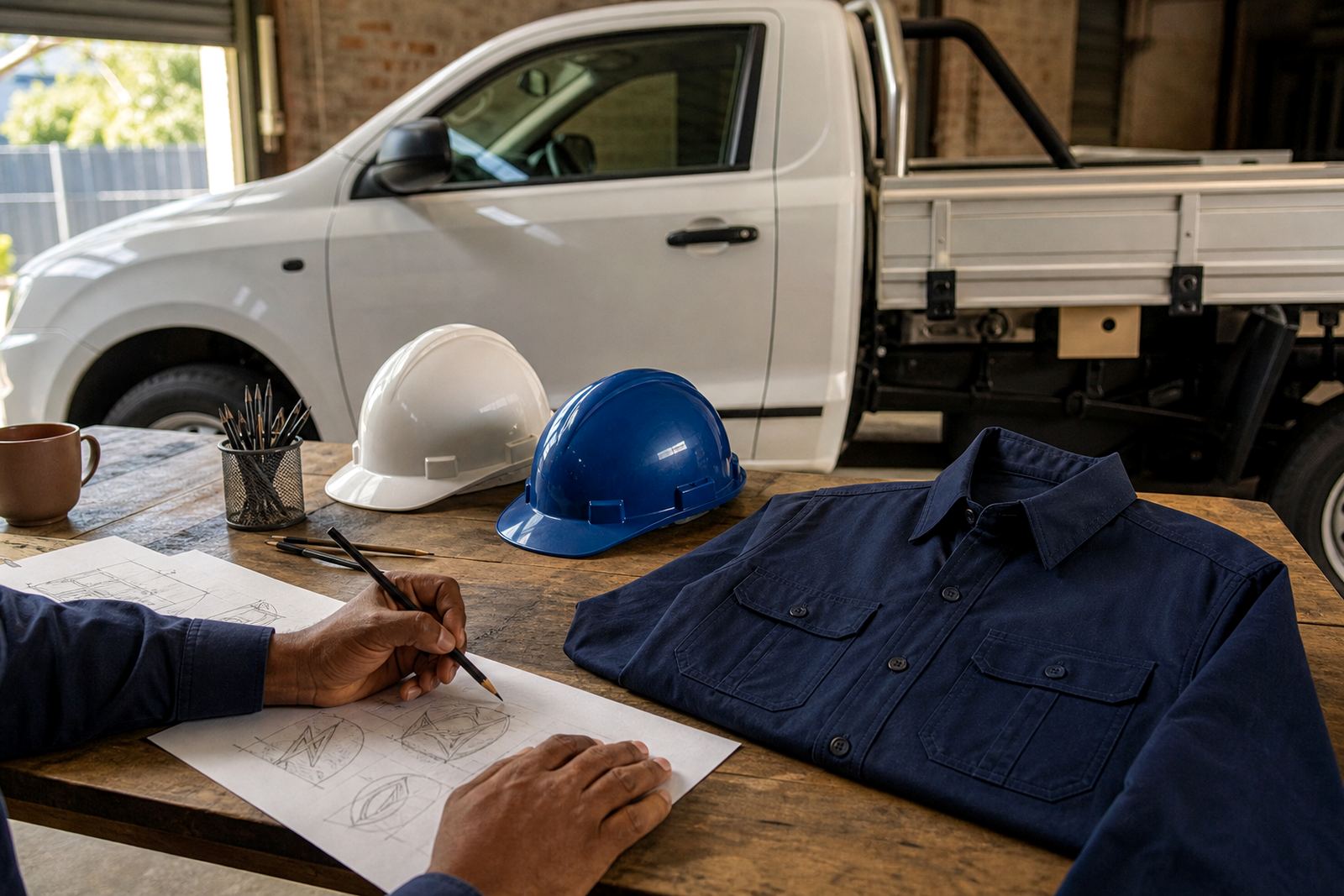
Contractor branding works best when the artwork is planned around the item it will sit on. A long logo may fit a bakkie door, but not the chest of a work shirt. A detailed illustration may look good on a quote cover, yet become too busy on a small sticker or hard hat. Planning size and placement early saves rework and helps the brand hold together across different uses.
In Cape Town, Johannesburg and Durban we often see mixed sets of equipment and documents needing the same artwork in several sizes, so consistency matters. Site boards, safety notices, quotation packs and vehicle graphics all have different viewing distances and surfaces, and coastal humidity in places like Cape Town or Durban can also affect how print and vinyl age over time.
- Keep the main logo simple for small applications
- Prepare a one-colour version for stamps and basic print
- Allow space around the mark so it does not feel cramped
- Check that small text can still be read from a few metres away
- Ask for separate versions for vehicles, documents and workwear
Common mistakes we see on contractor branding jobs
One common mistake is using a low resolution picture and expecting it to print cleanly at large size. Another is sending different versions of the same logo to different suppliers, which leads to mismatched colours and uneven line work. We also see artwork with too much detail for a small surface, or fonts that look fine on screen but fall apart on a printed quotation or embroidered shirt.
If a business in Pretoria or Bloemfontein needs a reprint in a hurry, it is easier when the logo is already sorted into proper vector formats and each version is named clearly.
Budget ranges for contractors in Rand
Budgets depend on the condition of the source file, the amount of redraw work and whether the job is a straight logo rebuild or a more detailed illustration. A simple logo redraw for a contractor brand will usually sit at the lower end, while a detailed mascot, map, badge or scene illustration takes more time and planning. If you need multiple versions for vehicles, signs and documents, that also affects the scope.
As a general guide, many contractor jobs fall into these broad ranges: simple redraws for small print use, moderate redraws for clearer vehicle and document use, and more detailed illustration work for brands that need custom icons or mascot artwork. We can quote once we have seen the source image and know where the artwork will be used, whether in Cape Town, Stellenbosch, Paarl, Port Elizabeth or anywhere else in South Africa.
Because contractor work often needs both practical and print ready files, it helps to start with the most urgent item first, then build the rest of the artwork set from there. That keeps costs manageable and avoids paying for details you do not need.