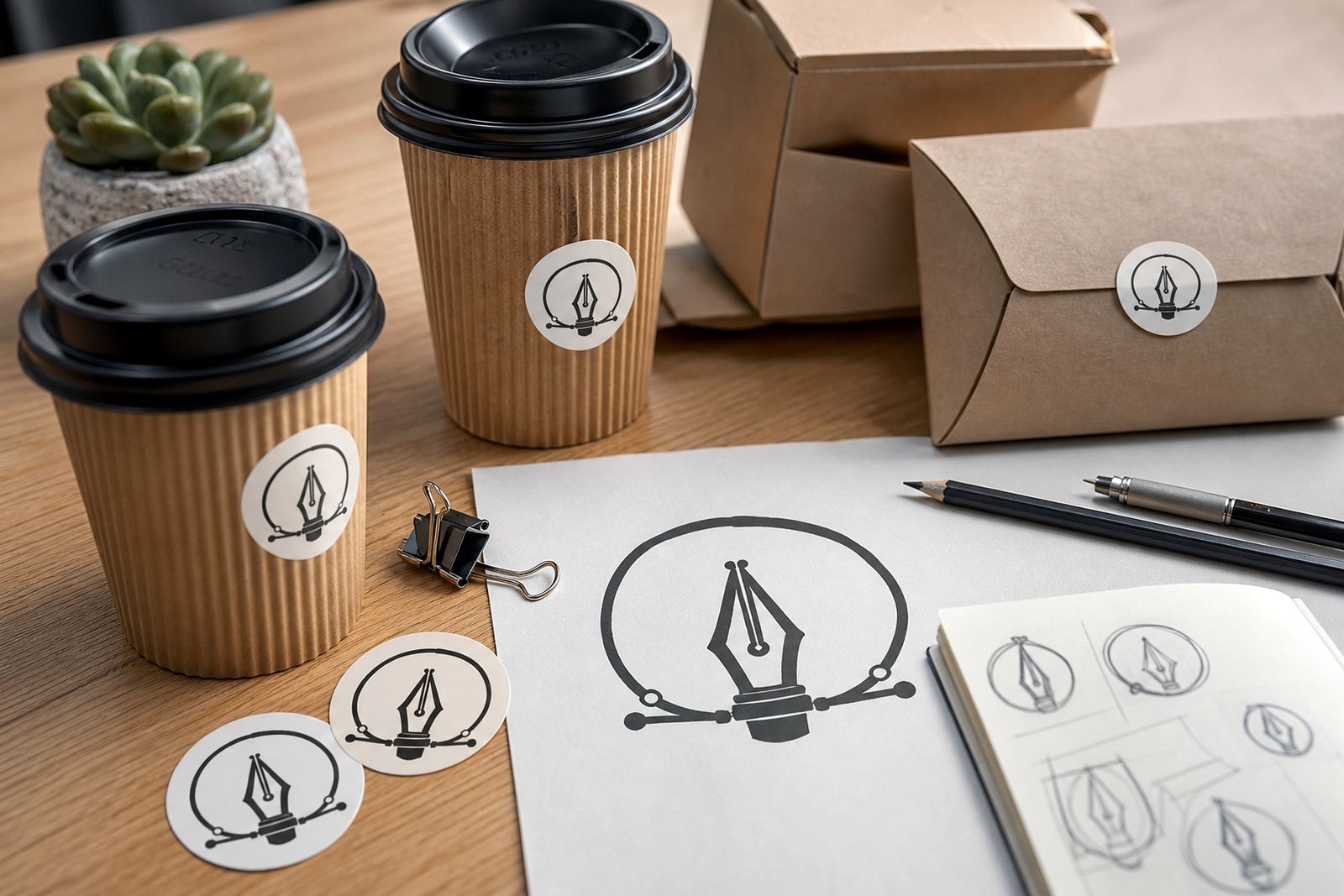
A restaurant seal that had to work in the kitchen and at the counter
The client was a restaurant in Umhlanga, KwaZulu-Natal, with a circular seal that had been used in many places over the years but was starting to show its age. It needed to hold together on laminated menus, condiment labels, receipt stamps and takeaway stickers, where small marks and thin lines can disappear fast. The original artwork was usable, but it was not clean enough for repeat print and there were a few uneven curves, cramped details and line weights that made the seal look tired.
The main goal was simple: keep the recognisable shape and restaurant feel, but redraw it so it would reproduce neatly on different substrates. Some applications would be full colour print, while others were one-colour stamps or low ink take-away labels, so the artwork had to stay clear even when scaled down. In practical terms that meant a proper vector rebuild, not just a quick trace, and a file set that a printer or signage shop could use without chasing missing edges or blurry corners.
- Client type: restaurant group in Umhlanga
- Use cases: menus, stamps, takeaway labels and small printed inserts
- Output need: clean circular seal with strong legibility at small sizes
What was wrong with the supplied artwork
The supplied artwork had been built from older files and image exports, so the edges were a bit soft and the circle was not perfectly balanced. On screen it looked acceptable at a glance, but when reduced for a stamp or label the weak areas became obvious. Tiny gaps, uneven spacing and text shapes that depended on bitmap pixels can cause real trouble when a printer needs clean plates or a stamp maker needs a crisp master. We also had to make sure the seal would not lose its character once the rough edges were removed.
We checked the mark as bitmap tracing and as a hand redraw, then chose the approach that would give the best control. Bitmap tracing is useful when a shape is simple and the source is clean, but for a seal with text, rings and decorative detail, a hand redraw gives better balance and better line control. That made it easier to correct the geometry, tighten the spacing and rebuild the seal as proper artwork that could be used again and again. The client confirmed they had rights to the artwork before we proceeded, which is essential on any redraw project.
- Problems found: soft edges, uneven line weight, awkward spacing and unstable small details
- Method chosen: hand redraw with selective tracing reference
- Rights check: client confirmed ownership or use rights for the supplied artwork
The redraw process and file formats supplied
The work was handled over three weeks. In the first week we cleaned the structure and mapped the seal into a neat vector layout. In the second week we refined the text, corrected the circle balance and rebuilt the linework for print. The final week was used for quality checks, export prep and file handover. The result was a more controlled seal that could be used on menus, labels and stamps without the muddy look that often comes from low-resolution artwork. It also sat better alongside other brand items, which is useful when a restaurant needs one visual identity across many touchpoints.
We supplied the final files in SVG, EPS, PDF and AI formats so the restaurant could hand them to different suppliers without trouble. SVG is useful for digital and web use, EPS is common in print workflows, PDF is practical for proofing and sending artwork to production, and AI is helpful for design teams that need editable source files. The seal was set up as a clean vector master with a one-colour version and a standard print version, so the same artwork could be handled by a stamp maker, a menu printer or a label supplier. That flexibility saved time later on and gave the client a proper working file set.
- Timeline: 3 weeks from brief to final handover
- Files supplied: SVG, EPS, PDF and AI
- Versions prepared: full artwork and one-colour use version
Where the seal now gets used
Once the seal had been redrawn, it could be used in places where the original file had been causing friction. The clearer lines meant fewer print errors and a better result on smaller items like stickers and takeaway lids. Menus benefited too, because the seal could be placed neatly without looking fuzzy or stretched. For a busy restaurant, that kind of consistency matters more than people think. Staff need artwork that is ready to use, not something that must be rescued every time a new supplier is involved.
The client also wanted a file set that would work across branches and seasonal menu changes, so the artwork had to be future friendly. We would handle this project the same way again for any restaurant that needs a seal, badge or menu mark cleaned up for print. Start with the source artwork, confirm usage rights, identify the problem areas, then rebuild the mark so it keeps its identity while becoming easier to print. A little bit of tidy-up goes a long way, and it usually saves a lot of back and forth later on.
- Practical result: better print clarity on small formats
- Operational benefit: fewer supplier issues and less rework
- Future use: suitable for menu updates, labels and branded packaging
Why hand redraw was the better fit than a quick trace
Many logos and seals can be traced automatically, but a quick trace often copies every wobble from the source file. That is fine for rough reference, but not ideal when the artwork has to look neat across multiple print processes. A restaurant seal especially needs balanced curves, readable text and clean joins where rings and icon elements meet. With a hand redraw, each part can be checked properly so the final result is not only sharper but also more usable for production. That makes a difference when the same artwork is going from a large menu to a tiny label.
For this project, the hand redraw gave us room to correct the geometry and improve the visual weight of the seal without changing its overall identity. The decorative elements were simplified where needed, and the spacing was opened up just enough to keep the text legible at smaller sizes. The final file set was then prepared for different print and digital uses, which is important when suppliers across South Africa need consistent artwork, whether the client is in Umhlanga, Cape Town or Johannesburg.
What we would use again on the next seal project
If we were doing this same type of project again, the process would stay focused on three things: rights, clarity and output control. First, confirm that the client owns the logo or has permission to use it. Second, decide whether the artwork is better suited to bitmap tracing or a proper hand redraw. Third, prepare the final files in formats that suppliers actually ask for. That approach keeps the job practical and avoids last-minute problems when a label printer needs one version and a menu designer needs another. It is a simple process, but it has to be done carefully.
For restaurants, cafés and hospitality groups, a clean seal can be a surprisingly useful piece of brand material. It appears on menus, carry bags, sleeves, tickets and labels, so the file has to behave in all those places. This Umhlanga seal now does that job neatly, with the linework cleaned up and the artwork ready for repeated use. The final outcome was not flashy, just properly sorted, which is usually what matters most in production. And once the artwork was fixed, it could be moved across suppliers without any fuss or guesswork.
- Best practice: confirm rights before redrawing
- Best method for seals: hand redraw where detail and spacing matter
- Best output: editable vector files ready for print and digital use
Key facts
| Project | Umhlanga Restaurant Seal |
|---|---|
| Client type | Restaurant in Umhlanga, KwaZulu-Natal |
| Scope | Redraw and clean-up of a circular restaurant seal for menus, stamps and takeaway labels |
| Timeline | 3 weeks |
| File formats | SVG, EPS, PDF, AI |
| Method | Hand redraw with vector rebuild and print preparation |