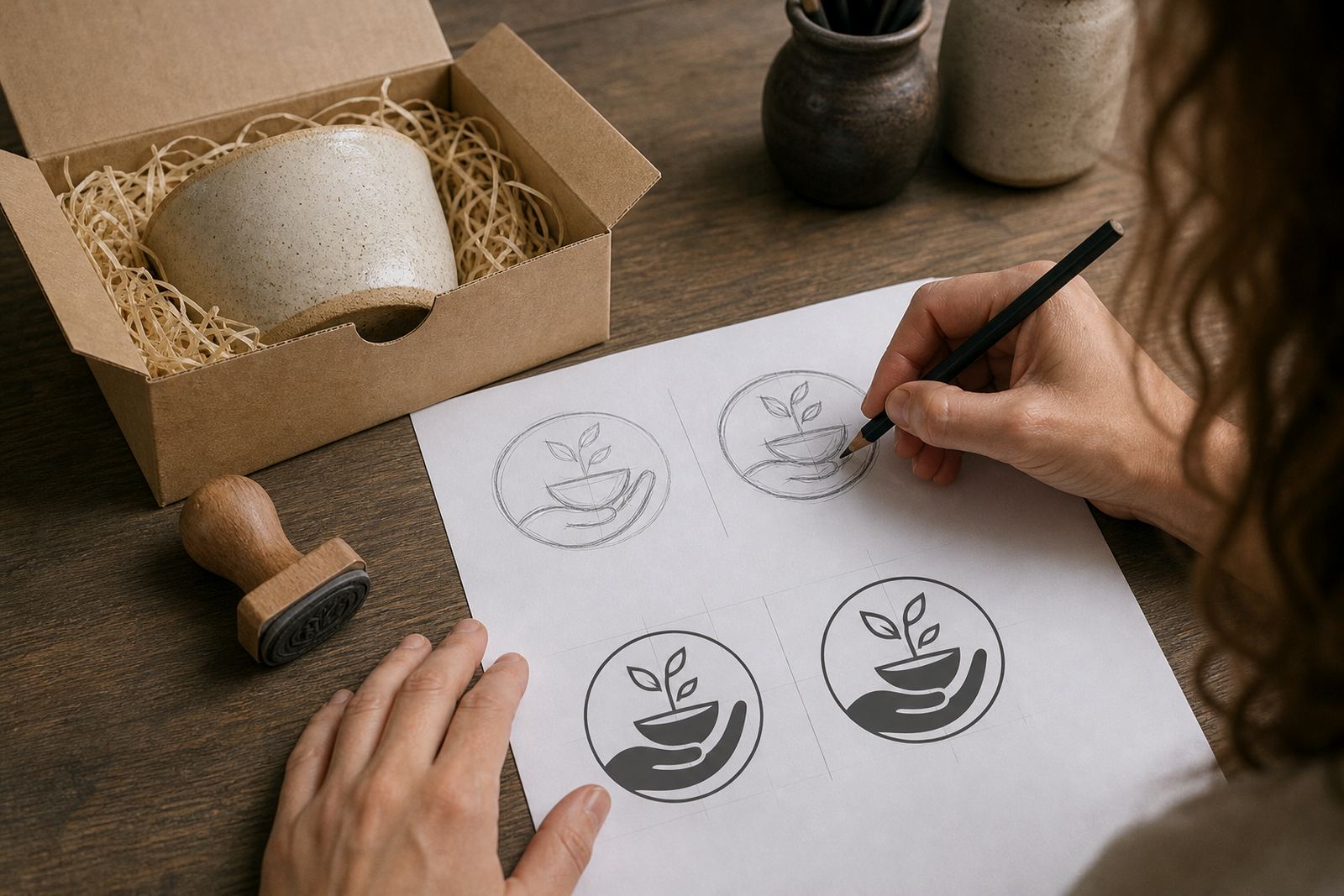
When a hand-drawn mark needs to travel further
Many artists start with pencil, ink or paint and later need the same mark to work on labels, tags, menus, inserts and online shops. A bitmap image can look fine on a phone, but once it is enlarged for a carton, poster or fabric transfer the edges can soften and the details begin to break up. That is where a proper vector redraw helps.
We work with businesses that need a logo cleaned up from a rough scan, a signature mark rebuilt as a precise vector, or a fresh illustration drawn in a similar hand-made style. The aim is to keep the feel of the original while making it practical for production. For artists in Cape Town, Johannesburg, Durban, Pretoria and Bloemfontein, this is often the point where branding starts to look much more professional, without losing its character.
- Sharp edges for print and signage
- Editable vector paths for future changes
- Files that scale from small stickers to large-format graphics
- Artwork prepared for suppliers and print rooms
Bitmap tracing or full hand redraw
Not every image needs the same treatment. Bitmap tracing is suitable when the source is clear, the shapes are simple and the goal is to rebuild existing artwork fairly closely. A full hand redraw is better when the source is fuzzy, low resolution or built from uneven scans and screenshots. If the original has pen pressure, brush texture or imperfect lines, a skilled redraw usually gives a cleaner result than automated tracing.
For artists and makers, this matters when the final use includes packaging labels, art prints, foil stamping, embroidery, screen printing or a webshop banner. Automated tracing can leave too many nodes and awkward corners, which causes problems later. A careful redraw keeps the artwork manageable, neat and easier to print. It also gives you more control over line weight, spacing and the overall balance of the image.
- Use tracing for simple logos with strong outlines
- Use hand redraw for textured marks, icons and illustrations
- Use illustration work when the original idea needs new detail or a different layout
- Ask for both if you need a master file and a simplified print version
Files, formats and the way printers prefer them
Most print suppliers and sign makers prefer vector files because they scale cleanly and are easier to separate for production. We can prepare artwork in SVG, EPS, PDF and AI formats, depending on how the files will be used. SVG is useful for web and digital shops, EPS is still common for print workflows, PDF is practical for sharing with suppliers and AI is helpful where editable layered source files are needed.
If your artwork is going onto packaging in Cape Town or being sent to a printer in Johannesburg, the file setup can save time later. We usually think about line thickness, safe margins, colour builds, black-only versions and whether the artwork needs to work on light and dark backgrounds. Coastal humidity can affect stock and labels too, so a tidy file with clear instructions helps when a printer is choosing the right paper, film or board.
- SVG for websites, online shops and digital graphics
- EPS and PDF for print shops, packaging and signage
- AI when layered source artwork is required
- Single colour, full colour or reversed versions if needed
Layout planning for packaging, prints and online shops
Artists and makers often need more than one artwork size from the same concept. A badge for a candle label may need a circular layout, while the same motif might need a wider horizontal version for a website header. We help plan artwork so it fits the real spaces on your products, instead of forcing one image into every use-case.
Good planning also means thinking about readibility at small sizes. Fine hatching, tiny type and narrow shapes can disappear on stickers or folded inserts. If you sell at markets in Stellenbosch or Paarl, your labels need to hold up under handling and sunlight, and they should still read clearly when a customer is standing at the table. Keep the layout simple where possible and leave room for product details, batch info and barcodes where relevant.
- Check the smallest size the artwork must reach
- Allow margins for cutting and folding
- Keep artwork clear on both white and coloured stock
- Plan separate versions for packaging, print and social media
Common mistakes that slow down production
Most delays come from poor source files. A phone screenshot, a blurry scan or a flattened image with no layers makes accurate work harder. Another common issue is sending artwork without clear proof that the client owns the rights or has permission to use it. If you commission a redraw or illustration, please only send artwork you own or have rights to use, because that protects everyone involved.
Other mistakes include asking for too much detail in a tiny label, changing the brief halfway through, or not checking how the artwork will sit next to text. We also see clients forget that screen printing, embroidery and foil work each have limits. What looks good on a screen may need simplification before it can be produced properly. A quick review before final sign-off saves time and money.
- Blurry source images
- No permission to use the original artwork
- Too many fine details for the final size
- Late changes after the layout has already been approved
Typical budget ranges for South African makers
Budget depends on how much rebuilding is needed, the number of versions required and whether the work is a simple redraw or a more detailed illustration. A straightforward logo redraw with one main file set will usually sit in a lower range than a custom mascot, packaging scene or illustrated badge system. If you need several variations for packaging, web banners and stickers, the cost will rise with the scope.
For South African small businesses and makers, it helps to budget in stages. Many start with a main logo redraw, then add a few supporting icons or illustrations later. That keeps the work manageable and lets you test what actually sells. As a broad guide, many projects fall somewhere between R1,500 and R12,000, depending on complexity, file versions and revision needs. Larger illustration suites can run beyond that when there are multiple artworks, formats and product uses.
- Simple redraws: lower budget range
- Detailed illustrations: mid range
- Multi artwork packaging systems: higher range
- Always allow room for final file prep and revisions
How we work with artists and makers nationwide
We are based in Observatory, Cape Town and work with clients across South Africa, including Port Elizabeth, Durban, Pretoria, Bloemfontein, Johannesburg and the surrounding areas. The process usually starts with an enquiry through our contact page, followed by the source artwork, your notes on use-case and the final sizes you need. From there we map out the redraw or illustration, tidy the file structure and prepare the output formats.
Our team includes Luyanda Mthembu, Ayesha Mafokeng, Pieter Skosana, Zanele Kajee, Teboho Molefe and Megan Khoza, each handling a different part of the job from artwork creation to quality checking. That mix is useful when a maker needs both a personal touch and production-ready files. If you are working on packaging, prints or an online shop and need the artwork to hold up in real use, this is the stage where careful vector work pays off.