What a signature redraw actually gives you
A signature logo is usually built from a handwritten name, a quick mark, or a scrawled word that looks good at one size but starts to break up when it is enlarged. Our signature redraw service turns that artwork into neat vector artwork with smooth curves, balanced spacing, and clean edges. The result still looks personal, just less fragile when you need it on a shop front, invoice, label, or vehicle magnet.
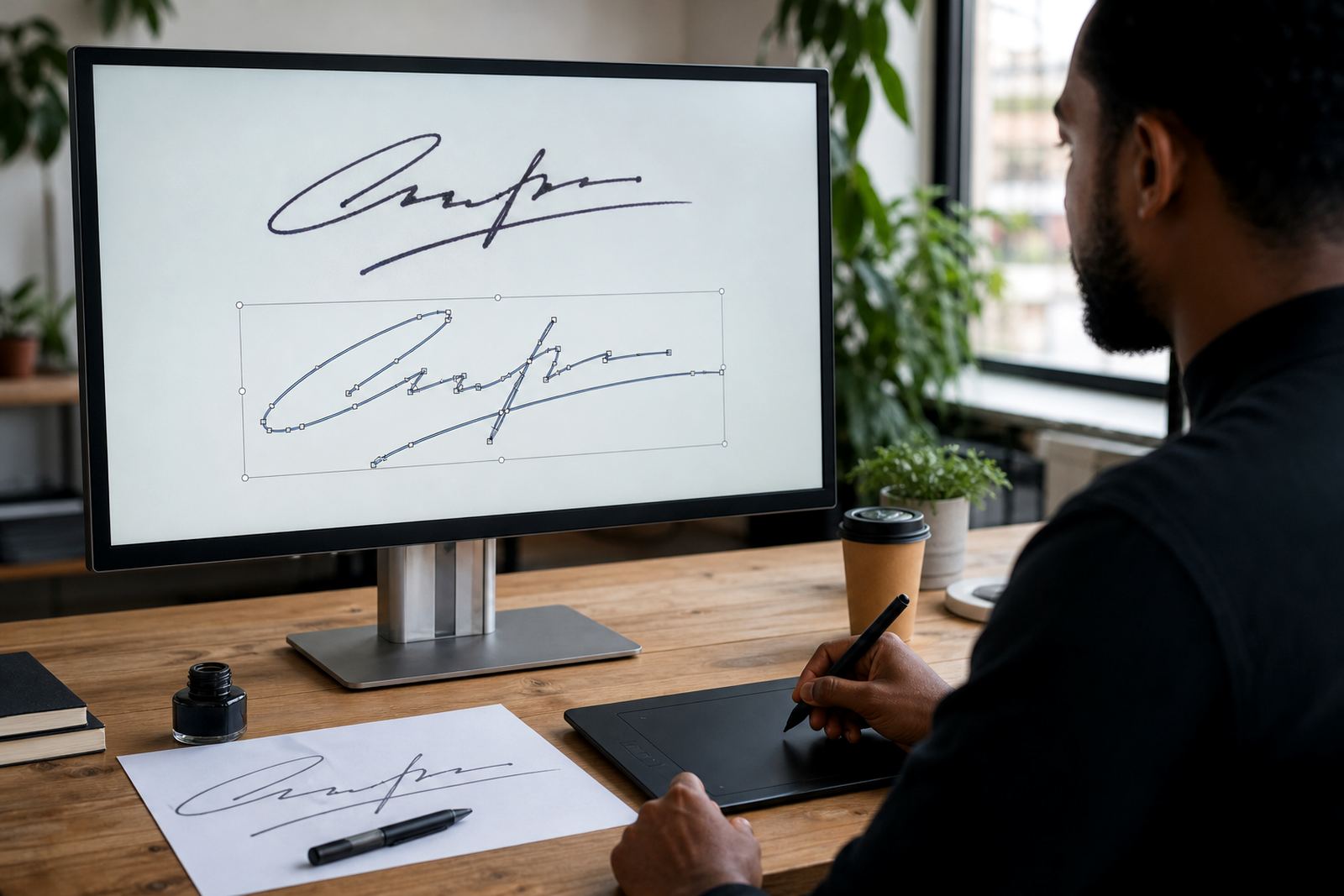
We work from artwork you own or have rights to use. That can be a photo of a sketch, a flat image, a scan, or an old logo file that has gone soft over time. Where the original is suitable, we may trace it as a starting point. If the lettering needs more care, we redraw it by hand so the final result feels natural instead of stiff. The aim is not to make it generic. It is to make it usable without losing the style that people recognise.
Tracing versus hand redraw, and when each suits
Bitmap tracing follows the pixels in a low-resolution image and converts them into vector paths. It can work well when the original is already clear and the letterforms are simple. Hand redraw is different. We study the shapes, weight, joins and spacing, then rebuild the logo with proper curves and cleaner structure. For signature marks, this usually gives a better finish because handwritten strokes often need small corrections to stay legible at larger sizes.
- Use tracing when the source is sharp, the letters are simple, and you mainly need a cleaner file.
- Use hand redraw when the logo has uneven strokes, awkward joins, or needs better balance.
- Use illustration support when the signature is paired with icons, flourishes, or a border that must also be rebuilt.
- Use full vector rebuild when the original file is too pixelated, cropped, or damaged to trace properly.
For South African businesses this matters when the logo must survive a range of uses, from a small social avatar to a big printed sign in bright coastal sun. A tidy vector file holds its shape better, and it is much easier for printers and sign makers to work with. It also helps when municipal or landlord rules require neat artwork for boards, window graphics, or awnings.
Common uses for signature-style logo redraws
Signature marks suit brands that want a personal feel, a founder’s name, or a handwritten touch that softens a formal identity. We see them used by consultants, salons, makers, cafés, property firms, and small professional practices across Cape Town, Johannesburg, Durban, Pretoria, Bloemfontein, Port Elizabeth, Stellenbosch and Paarl. They also work well when a business wants to keep the warmth of a handwritten logo while improving the practical side for print and digital use.
Because the artwork is vector based, it can be resized without going blocky. That makes it useful for everything from letterheads to wall graphics. It also means the file can be separated into one colour, reversed out, or prepared for a printer who needs a clean outline for cutting, embossing or foiling.
- Shop signage and window vinyls
- Business cards, flyers and letterheads
- Labels, tags and packaging sleeves
- Menus, brochures and presentation folders
- Website headers, social graphics and message signatures
Sizes, options and file formats you can order
Signature redraws are not sold by physical size in the usual sense, because the artwork is built as a vector and can be exported to the dimensions you need. We prepare the master artwork and can supply versions for small print, large format use, and digital display. If you need multiple arrangements, such as stacked, horizontal, single-colour, or reversed versions, we can set those up from the same approved artwork.
File formats commonly supplied include SVG for web and scalable use, EPS for print production, PDF for easy sharing and proofs, and AI for editing in vector software. Where useful, we can also supply a flattened PNG or JPG for quick reference. If your printer or signage supplier asks for a specific format, tell us up front so we can set it up properly, rather than sending a file that needs extra fiddling later. That saves time and avoids issues at the print stage.
- Single logo redraw for one signature wordmark or signature and sub-line
- Format packs for print, web and production teams
- Colour variants for black, white, one-colour and reversed use
- Artwork cleanup for rough scans, blurry files or faded originals
What to check before you send the artwork
The best results start with the clearest source you have. A scan at 300 dpi or higher is useful, but a crisp photo taken straight-on can also work if the image is flat and well lit. If the signature has been used for years, send the version you want preserved, not just the first file that comes to hand. We can work from older artwork, but the better the source, the less guesswork is needed. It also helps if you tell us whether the redraw must match the original exactly or whether small refinements are allowed.
- Confirm that you own the artwork or have permission to use it
- Send the best available file, scan or photograph
- Say where the logo will be used: print, signage, web or packaging
- Note any must-keep details, such as a flourish, underline or initial
- Tell us if the final file must be one colour, full colour or both
If your brand uses a signature alongside a crest, icon or illustration, send those together so the parts can be matched properly. That helps with spacing, line weight and the overall look. We also ask about the final size and substrate where relevant, because a logo for laser cutting, embroidery or foil stamping may need slight adjustments.
Care, servicing and handover details
Once the redraw is approved, the artwork files should be stored safely and shared with everyone who prints or applies your branding. Vector files do not need ongoing servicing in the way that physical equipment does, but they do benefit from sensible file control. Keep a master version, keep a backup, and avoid editing the approved artwork in multiple places. If a new supplier needs a different format later, we can usually export it from the master file.
No on-site setup is needed for this product. It is a file-based service, so the practical work lies in artwork preparation and your approval of the final proof. If the logo will be used on signage, packaging or decals, the printer or sign writer may have their own substrate and fitting requirements. In coastal areas like Cape Town and Port Elizabeth, it is worth checking material choice too, since humidity and sun can affect the finish over time.
We also advise keeping an eye on how the logo is reproduced after delivery. Bad scaling, stretching, or exporting the wrong file type can undo a clean redraw. If a supplier needs help understanding which version to use, the simplest answer is usually the vector master for production and the PDF or PNG for reference.
Key facts
| Service type | Signature-style logo redraw and vector rebuild |
|---|---|
| Artwork source | Customer-owned or rights-cleared artwork only |
| Methods | Bitmap tracing, manual vector redraw, or a mix of both |
| File formats | SVG, EPS, PDF, AI, plus PNG or JPG on request |
| Best use cases | Print, signage, packaging, web graphics and brand touchpoints |
| Coverage | Observatory, Cape Town and clients across South Africa |